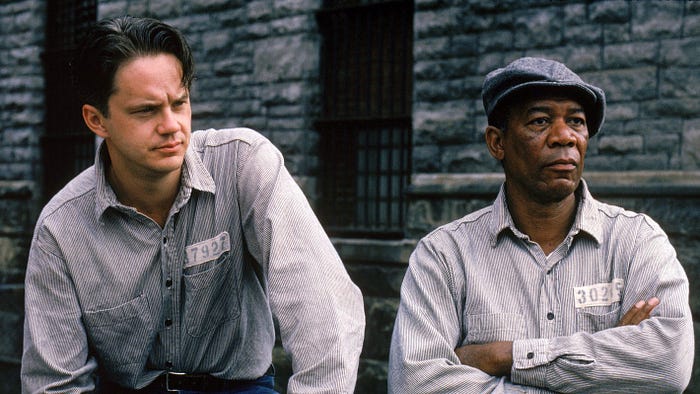

The Shawshank Redemption is by no means the first, or only film to portray a character's experiences in prison. It is unique, however, in that it takes such a passive role in telling this kind of story. The plot of the film, if it even has one, is meandering. The film seems content to let us follow its events from a distance, like one of the extras in the movie's main friend group. We are present, perhaps, but as a bystander. Oftentimes, during the film, this leaves us with a feeling of aimlessness- "What is the purpose of all this? What is this building to?"- and that's exactly the point. The prisoners are in the same boat as us. They eat, sleep, barter with money and cigarettes, and trek over to their once-a-decade parole hearings without the slightest expectation that any of it will ever amount to anything. They are institutionalized. This is all they know. This is all they may ever know. In depicting this, in 1994, Shawshank was near revolutionary. Despite being released 25 years ago, the film remains a vital commentary on institutionalization in the U.S. criminal justice system, and serves to humanize inmates by depicting their lives in prison.
We see the story of The Shawshank Redemption not through the lens of its protagonist, Andy, but via Red, his closest friend. Save for the opening scene of the film, in which the murder Andy is charged with takes place (and which we see from a deliberately limited perspective), all of the action is narrated by Red. This, to us as viewers, makes sense. We are introduced to Andy at the same time the rest of the inmates are. We are wary of him, naturally, considering what we are led to think he's done, but his true character is revealed to us through his interactions with Red and the other prisoners. We don't need much screen-time with Red to trust him. We sympathize with him the moment we are introduced to him, when he is ungraciously denied parole. Red is well-liked by his peers, and carries himself with a wise air of dignity. And so, when he takes a liking to Andy, so do we. As their relationship develops, we grow fonder of Andy until he is truly one of the gang, his initiation complete when he secures 3 beers a piece for each member of the roofing group. Or perhaps not until he captivates all of Shawshank by playing Mozart over the PA system. Either way, when Andy christens new inmate Tommy with the old "everybody's innocent in here" refrain, we know it's been done.
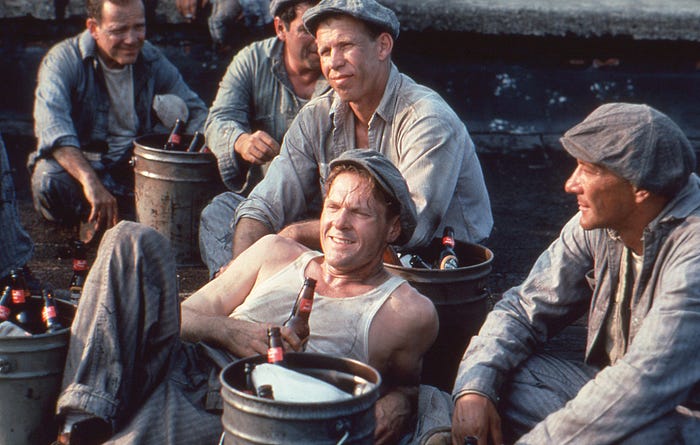
This is seemingly a celebratory moment, Andy's inauguration as "one of the gang", so to speak. However, it actually symbolizes something far more sinister. This friend group is made up primarily of lifers. They may all be friends, but it is only by circumstance. They may have forged real connections with each other, but those connections are heightened by the fact that none of them could leave, even if they wanted to. Now that kind of shared bond, a common struggle, is something that often does lead to stronger, lasting friendships. But this group is also a reminder of the permanent constraints lifers have. Red, one of the leaders of the group, embodies this. He's been in Shawshank for most of his life, and knows what happens when people like him are let out into the world. "Institutionalized", he calls it, like it's the bogeyman. He refuses to get his spirits up, because he knows that, for lifers, what's on the other side of the rainbow isn't half of what it's cracked up to be. All Red's time in prison has robbed him of the ability to have a life afterwards. It is sad then, when Red tells Andy that "hope is a dangerous thing". It isn't always, as we as viewers know, especially not for an innocent man. But in the context of Shawshank, that advice is almost true. It'd be better for the inmates if they didn't get their hopes up for life on the outside. They'll be like Brooks, the inmate that tends to the library. Helpful to the prison, subordinate, and content to spend the rest of their lives rotting away there.
The board at Red's parole hearings ask if he's been "rehabilitated", and he rightfully calls them out on the farcical nature of the whole thing. Yes, in fact, Red has been "rehabilitated". We never knew him when he was young, but we know he regrets the choices he made then. We know he's an honest man, and a good friend. Shawshank did its job, at least on him. But you get the hunch the parole board doesn't give a damn about whether or not he's changed for the better in the time he's served; they just need to hear a compelling enough argument. Red doesn't seem to be fazed when he is rejected parole. He moseys off, a time jump ensues, and the banality of his life in prison continues, uninterrupted.
This- the somber, winding way in which The Shawshank Redemption is told- forces us to empathize with Red, and, ultimately, prisoners in general. When we see Red, someone we respect and trust as the protagonist of the film, subjected to this unfair treatment by the parole board, it resonates. We don't feel only for Red, either, particularly considering he is one of the only inmates we know for a fact actually committed a heinous crime. When the film reveals that Andy is in fact innocent, it reframes the entire story to that point as something far more tragic. If Andy, a well-respected and educated white man, can suffer miserably the way he does over the course of the movie for a crime he didn't commit, imagine how many countless young people of color must be suffering the same fate. The film never frames the prisoners as innocent, but it frames them as people. People with their own problems, maybe, but still people, deserving of rights, and fair treatment, and eventually, a shot at freedom. For that alone, it deserves commending.