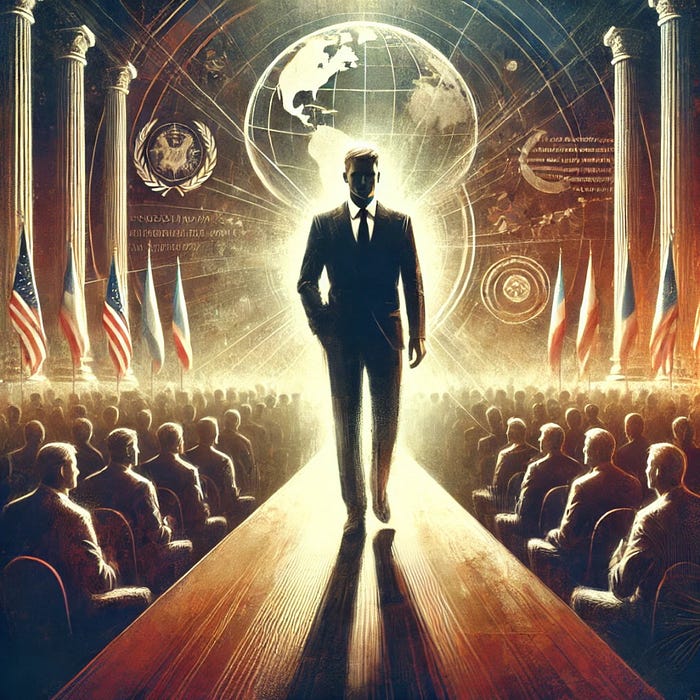


Disclaimer: The views expressed in this article are an analysis of Donald Trump's leadership style and political strategy. They do not necessarily reflect my personal agreement or disagreement with his policies. The focus is on understanding his unconventional approach to leadership and its impact, rather than endorsing or opposing any specific political stance.
Donald Trump is a paradox. People can predict certain actions from him but never truly know what he will do next. He is blunt yet strategic. The direct nature of his statements leaves many people to misinterpret him as incompetent but his lack of political correctness makes him effective as a leader. Through his unconventional leadership style Trump has accomplished becoming a highly influential person of the 21st century.
His success is not accidental. In contrast to traditional politicians Trump has mastered the understanding of human nature together with power dynamics and influence mechanisms. The way Trump successfully moves through politics stems from more than his financial status or headlines in media. The combination of natural ability with well-timed actions gives him an exceptional talent to steer public narratives.
The Power of Being Unconventional
Great leadership throughout time has yielded frequent misinterpretations from people.
Niccolò Machiavelli once wrote:
"It is not titles that honor men, but men that honor titles" (Machiavelli 1532).
Trump embodies this idea. His ability to gain political victory stemmed from his transformation of political leadership rather than his background in experienced political work.
His communication methods differ from typical political representatives because he depends on spontaneous conversations instead of prepared speeches and statements. He delivers his messages without reservation and his words frequently spark debate but they constantly register strong effects. This approach confounds world leaders and political analysts. His unpredictable nature maintains him at a constantly high state of alert among his friends and his enemies.
The unconventional approach Trump chooses in politics provides him with strategic benefits.
Sun Tzu, in The Art of War, advises:
"Appear weak when you are strong, and strong when you are weak" (Sun Tzu 5th century BCE).
Trump applies this principle masterfully. Although Trump seems disorganized he plans every action with precise strategy.
Disrupting the Political Landscape
Traditional political conduct used to dictate decision-making processes until Trump entered the political scene. The political era under Trump involved leaders who spoke diplomatically while following standard political protocol. Trump changed that. Trump brought forth an entirely different political approach through his direct and confrontational stance which heavily relied on media presence.
Social media under Trump's direction established entirely new ways political representatives communicate with the public. Through bypassing traditional news networks he could speak directly to millions of people at once. His control of the message remained unfiltered through this approach.
Plato once said, "Those who tell the stories rule society" (Plato 375 BCE).
Trump understands this deeply. Through his personal storytelling he governs public opinion during the present moment.
The methods he uses frequently annoy high-level political figures. Several world leaders use extended planning and strategic partnerships and methodical dialogues for dealing with challenges. Through his swift actions and unforeseen direction-changing moves Trump disturbs established political systems. The unpredictability of his approach allows Trump to gain advantage in his diplomatic engagements.
The Psychology of Influence
The reason behind Trump's broad popularity extends past the basic political sphere. He understands human psychology. Laureate identifies that people gravitate toward individuals who present confidence while simultaneously demonstrating decisiveness and defiance traits.
Friedrich Nietzsche argued, "He who has a why to live can bear almost any how" (Nietzsche 1889).
Trump gives his supporters a strong "why." Through his public persona Trump shows himself as an opponent to the traditional establishment while defending the marginalized people and acting as an embodiment of anti-Political Correctness resistance.
This emotional connection is powerful. The majority of politicians depend on policy details and logical explanations. Trump uses identity along with emotion and loyalty as his primary methods of appeal to voters. As a leader he recognizes that people keep the emotional impact of their actions in their memory better than the exact details of their policies.
The ability of self-branding represents critical success for him. From "Make America Great Again" to "Fake News," his phrases become cultural markers. These straightforward easily memorized statements improve his power to influence others.
Aristotle noted that "character may almost be called the most effective means of persuasion" (Aristotle 4th century BCE).
The personal character of Donald Trump stands as his strongest persuasive method.
The Art of the Bluff
The large-scale unpredictable actions along with bold announcements made by Trump remain one of his most controversial traits. Some see this as recklessness. Two different opinions exist about this negotiating approach.
Through the lens of game theory uncertainty operates as an effective strategic method. Your opponents remain at defense mode once they cannot identify your upcoming actions. Trump uses this approach when dealing with opponents within his own country as well as international political figures.
When Trump keeps his opponents guessing he makes them revise their entire approach.
The situation sometimes reveals critics attempting to expose his bluffing but Scaramucci consistently creates opportunities to prevail from these moments. His capacity to transform discussions while defending his position and making additional claims results in his maintaining control over dialogue.
The Paradox of Popularity
The public supports Trump strongly even though commentators regularly criticize him. His appeal extends beyond politics. His role in politics stretches beyond typical leadership roles because he symbolizes an anti-establishment approach.
Jean-Jacques Rousseau wrote once:
"The world of reality has its limits; the world of imagination is boundless" (Rousseau 1762).
The political manner of Trump confuses real events with how they are perceived. People who support him view him beyond his political role as both an organizational force and an emblem of elite opposition.
This loyalty frustrates his opponents.
Numerous observers fail to comprehend how his political following maintains loyalty throughout all publicity challenges. Supporters adhere to Trump because they experience that they receive attention from him. The open and challenging style combined with media resistance that Trump exhibits helps his followers experience a feeling of united conflict.
Conclusion
The political world has not seen a leader like Donald Trump. Modern political trends fail to classify this person because he stands apart from the norm. The distinctive capability of Donald Trump to reshape storytelling and gain narrative authority differentiates him from other leaders. His impact stands as indisputable regardless of the stance people hold regarding him.
The core elements of his achievement stem from how he understands power dynamics along with human influence capabilities and psychological behavior. His conduct contains principles which can be traced back to Machiavelli and Sun Tzu as well as Nietzsche no matter whether it occurs unconsciously or not. The method he uses in politics is far from arbitrary because it represents a strategic design.
Historians will interpret Donald Trump differently from their various perspectives. People will either view him as revolutionary or forward-thinking leader. The way he has transformed leadership will endure as a major achievement of the contemporary era.
References
Aristotle. Rhetoric. 4th century BCE.
Machiavelli, Niccolò. The Prince. 1532.
Nietzsche, Friedrich. Twilight of the Idols. 1889.
Plato. The Republic. 375 BCE.
Rousseau, Jean-Jacques. Emile, or On Education. 1762.
Sun Tzu. The Art of War. 5th century BCE.