

In my current Character Development Keys course, one of the writers participating in the course Larry Keeton raised this question:
This is more of a process question based on curiosity. In the novel/short story world, there is always the discussion of plotter versus pantser. Which has led me to wonder about the screenwriting industry.
Given the nature of screenplays, it would seem to me that a writer must have a story somewhat finished before writing a script. It's my understanding the story may or may not be fleshed out in terms of character. Do screenwriters then focus on developing character bibles as they proceed to writing the script? Or do they "pants" it, letting the dialogue and action take place as they write?
Here is my response:
Larry, an excellent question. In order to answer it, let's divide the screenwriting project into two categories: Paid Gig | Spec Script.
If it's a Spec Script and the writer doesn't have a specific due date, they can "pantser" all they want. Start with a concept, type Fade In, and off you go! I don't recommend that approach as the less prep work a writer does, the more likely their story will crash and burn somewhere in Act Two. This has been my experience as a teacher for over two decades, many if not most of the writers who take my Prep: From Concept to Outline workshop have had that experience of getting lost and giving up because they tried to "pantser" their way through the script. But as I always say, "There's no right way to write," so if a writer isn't working under the pressure of a ticking clock, and they prefer to wander their way from Fade In to Fade Out, whatever!
If the project is a Paid Gig, that is an entirely different scenario. For instance, in the TV world, no one goes to script unless the writing team has broken that script down scene-by-scene. I can't speak to how one-writer shows like Mike White and White Lotus operates, but if it's a conventional TV series with a writers room, inevitably they break each episode down to each scene before going to script. Why? Because of the ticking clock! There is little to no room for error, so when they send one of the writers on staff off to knock out a script for Episode 205 (for example), that writer has an outline to guide the page-writing process.
With features, there's more latitude for writers who are inclined for "pantsing" a script, but not much. If you sell a pitch or land an OWA (Open Writing Assignment), the typical deal gives the writer 10–12 weeks to turn in a draft. If it's a pitch which the writer has worked out much of the story and they don't need to do a lot of revisions based on studio notes, the writer is working with a story that's already pretty well outlined. They'll usually still do prep work on it — subplots, character development, detailing the overall structure, and so forth — before typing Fade In.
If, on the other hand, it's an OWA, depending upon if it's a wholly original story or a rewrite of an existing script, writers almost always spend at least a few weeks "breaking" the story. While it may seem counter-intuitive to spend, let's say, 4 weeks out of 12 weeks for script delivery, it actually speeds up the process. For example:
4 weeks: Prep 4 weeks: 1st draft 2 weeks: 1st revision 2 weeks: 2nd revision
Here's the thing we need to remember: When William Goldman said, "Screenplays are structure," there's a world of truth in that observation. Mind you, that is not just plot. That's only part of the structure, there is a whole other realm — the psychological journey — that not only informs the plotting process, but gives the story its emotional core — the heart and soul of the characters.
Let me wrap up by saying I always advise writers who are tackling a screenplay to do prep work and create a scene-by-scene outline. At least one time. They may hate it, but more often than not, I have found writers learn how valuable it is to break story before typing Fade In. You are much more likely to get to Fade Out … and end up with a solid first draft than if you "pantser" your way through the writing process.
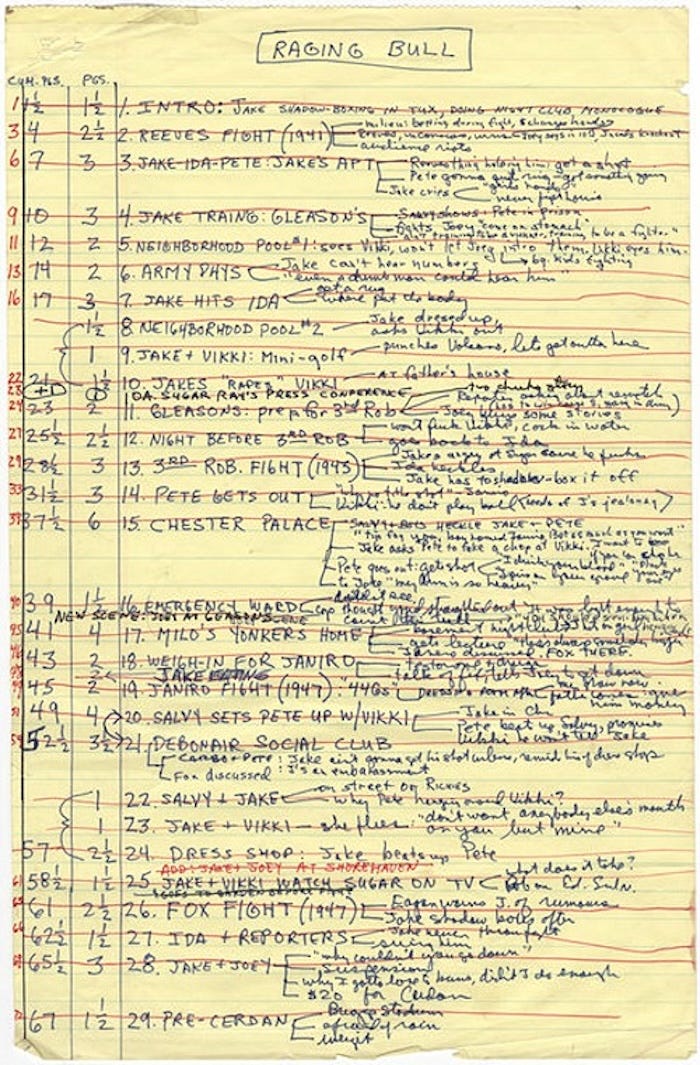
As I always say, there is no right way to write. But if you take on a screenwriting gig with a deadline, you'd be wise to be a plotter. Consider Paul Schrader's thoughts on the matter:
"I know exactly where I'm going beforehand. I know to the half page if I'm on or off target. I draw up charts before I do a script. I endlessly chart and re-chart a movie. Before I sit down to write, I have all the scenes listed, what happens in each scene, how many pages I anticipate each scene will take. I have a running log on the film. I can look down and see what happens by page thirty, what happens by page forty, fifty, sixty and so forth. I have the whole thing timed out to a hundred and five, a hundred and ten pages. You may go two, three pages ahead or behind, you may add or drop dialogue or scenes; but if you're two pages ahead or behind, you have to work that into the timing. Especially if you get five pages ahead, or, worse, five pages behind, then something you had planned to work on page forty may not work the same way on page forty-five."
Now THAT'S a plotter!