
In this X thread, I explain the idea of Science Audit.
This article will be part of the Quantum Mechanics Audit Report series. The series introduces a four-stage audit method (Challenge 0–3) designed to make every quantum mechanics calculation transparent: publishing not only the result, but also its error, limits, and patches on the same page.
If you are new to the series, start with the main article Quantum Mechanics Audit Report — Introduction. There you will find the full explanation of the audit framework and the first worked example (double-slit experiment).
This current piece (Example) applies the same audit method to a two-level quantum system: the estimation of the Rabi frequency from oscillation data.
Challenge 0 — Solve the equation from data
System: two-level atom driven by resonant monochromatic field. Population oscillates at Rabi frequency Ω.
Equation:
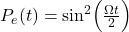
If measurement yields oscillation period T:

Example: T = 5.00 μs →

Challenge 1 — Error equations next to result equations
Propagation of uncertainty (Taylor 1997):

Fit-based timing error:

Challenge 2 — Compute the numerical margin of error
Given measurement:

From this we compute:
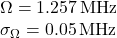
Interpretation of notation:
- The central value is Ω = 1.257 MHz
- The standard uncertainty (1σ) is 0.05 MHz
- Writing them side by side in physics shorthand:

This means:
- Value = 1.257 MHz
- Uncertainty = ±0.05 MHz (1σ)
Challenge 3 — Limits, patches, interpretation
Limits & domain: resonant case, two-level approx, homogeneous field, coherence ≫ T.
Patches: detuning → generalized ΩR, damping if decoherence, calibration of clock drift.
Interpretation: "This experiment measures oscillatory population transfer. The result Ω = 1.257(05) MHz is dominated in error by time-base calibration. Within the domain, this is a precise map of coupling — not an ontological claim about the wavefunction."
Minimal Audit Report
Result: Ω = 1.257 ± 0.05 MHz Reach: Limiting case = yes ✔ Epistemic: not using causal/ontological physics = yes ✔ Quasi-reality: used statistics = yes ✔
- Ad hocs Listing:
- two-level approx
- resonant drive
- time-base calibration
References
- Taylor (1997), An Introduction to Error Analysis
- Bevington & Robinson (2003), Data Reduction and Error Analysis
- Cowan (1998), Statistical Data Analysis
- Lyons (1986), Statistics for Nuclear and Particle Physicists
Read More
- More in X thread.