
Every startup begins with a bold thought — a spark challenges the status quo and imagines a better, faster, more human way of doing things. This article explores:
- Why startups struggle with execution
- What angel and PE investors expect
- A practical execution framework
- Lessons from real startup journeys (SaaS, edtech, CX, cloud, etc.)
- Leadership patterns that unlock scalable outcomes
Every startup begins when a founder spots something broken in the world — a frustrating process, a missing experience, or a disconnected system — and imagines a better way. That spark draws energy, rallies a core team, and often attracts angel investors who believe in the potential.
Sooner or later, though, the real question surfaces:
Can this vision turn into consistent, scalable execution? For many startups, that question becomes the turning point.
Having walked closely with founders and teams across the edtech, SaaS, deep tech, customer success, AI and cloud automation sectors, I often observe this pattern. Some ideas feel revolutionary. Investment flows in. Early adopters respond. And then… delivery stumbles. Goals blur. Priorities compete. Progress slows.
This phenomenon is what I call the execution gap — and it's not just common. It's structural.
In this article, I examine why startups struggle to execute their vision and offer a grounded, step-by-step framework to bridge that gap. I also reflect on real startup journeys (without naming them) across various industries — from immersive learning and automation platforms to asset tracking, SaaS platforms, and customer success tools. Through these experiences, one truth stands out:
Ideas excite. Execution delivers.
Part 1: Understanding the Execution Gap
1.1 What Exactly Is the Execution Gap?
The execution gap sits between intention and outcome. It forms when a startup has a clear strategic direction. However, daily actions, team rhythms, and customer value don't reflect it.
Research from the Harvard Business Review estimates that over 67% of well-articulated strategies falter due to execution issues. In early-stage startups, that figure rises sharply, especially around Series A or B, when growth expectations surge and investors expect predictable delivery.
Founders often feel blindsided.
"We build. We hire. We ship. Why don't things move as expected?"
The answer lies in the how, not the what.
1.2 Signs the Gap Has Opened
Startups don't suddenly fail. They drift. And the signals are often subtle.
In one B2B SaaS company focused on IT operations, the product enjoys a clear edge, but growth stagnates. Teams feel overworked but unaligned. Sprints continue, but releases lack impact. No one owns GTM clarity, and customer segments receive mixed messages.
Elsewhere, an edtech startup sees surging interest across geographies, but falters during deployment. A lack of localisation, stretched customer onboarding, unclear customer identification, and inconsistent content strategy disrupt scale. Here, vision remains strong, but execution struggles to carry it forward.
Both scenarios reveal the same pattern: effort without clarity, and activity without compounding value.
Part 2: What Angel and Private Equity Investors Look For
2.1 Angels Follow Belief — but Expect Discipline
Angel investors often enter when belief outweighs data. They backed the founder's fire, story, and early traction. But belief doesn't imply blind trust. Today's angels also expect operating clarity — even in the first 12 months.
In one early-stage services-to-product company, the founding team announces a bold pivot towards productisation. The idea receives initial support. But without clear MVP timelines, prioritisation discipline, or iterative feedback loops, investor confidence wanes. Execution — not funding — becomes the bottleneck.
Angels look for:
- A visible path from vision to prototype
- Structured sprints or shipping cycles
- Founders who listen, iterate, and communicate
Their role isn't to push daily targets, but to sense whether momentum feels intentional or accidental.
2.2 Private Equity and VC Investors Raise the Execution Bar
As startups attract institutional capital, expectations shift. Execution needs to scale, along with people, processes, and predictability.
A high-potential cloud automation firm enjoys $3M ARR and strong technical credibility. But when PE money flows in, weaknesses emerge. Decision-making is too close to the founder. Sales cycles stretch due to unclear ICPs(ideal customer profiles). Roadmap timelines shift. The PE partners, expecting operational maturity, request new leadership layers and execution dashboards.
It isn't unusual.
Investors at this stage want:
- Clear ownership across product, GTM, and success
- Defined metrics (like burn multiple, sales velocity, NRR)
- Cadence: weekly reviews, monthly retros, quarterly recalibration
- Founders who lead alignment, not every decision
An ICP isn't a vague persona — it's a targeting system. When sharpened, it acts like a sales compass:
✂️ Cuts wasted effort
🎯 Focuses on messaging
⚡ Accelerates conversions
"If your ICP doesn't make your sales team say 'That's EXACTLY who we want,' it's not specific enough."
Diagnose your ICP now: Do your top 5 customers fit a repeatable pattern? If not, revisit your ICP before scaling sales.
Put simply, PE wants execution to be independent of personality.
Part 3: Stages of Startup Growth — and Execution Focus
Startups pass through multiple phases. Each stage demands a different rhythm of execution. Startups are not code, capital, or charisma — they require rhythms. Rhythms of decisions, seasons of chaos, and moments when everything demands you grow faster than your comfort.
As a founder, your role is not static. It evolves significantly as the company grows. In the early stages, you operate as a builder. You are hands-on, doing the work yourself — writing code, talking to users, fixing bugs, managing logistics, and closing the first deals. As the company gains traction, you move into the role of a systems architect. You start building repeatable processes so that your business can function and scale without needing your involvement in every task. Eventually, your role shifts again. You become a strategic leader — a CEO focused on long-term vision, organisation design, capital allocation, and leadership development. This shift isn't optional. It's necessary. The founder who continues to behave like an early-stage builder at a late-stage company often becomes a bottleneck. Your key strength is not just execution, but knowing when to move from execution to delegation to orchestration. This transition — from sweat equity (your direct effort) to process equity (systems and teams that carry the load) — is what allows the company to scale sustainably.
For Angel Investors and Private Equity Professionals, your perspective also needs to evolve as the company's stage advances. Initially, your focus is on validating the problem. You want to determine whether the startup is addressing a genuine concern and if there is genuine demand. Next, your priority becomes retention proof. It's not enough for users to show up once — they need to come back. It is the stage at which product-market fit becomes evident. Establishing retention, the focus shifts to scalable unit economics. You're looking at customer acquisition cost (CAC), lifetime value (LTV), gross margins, and operational efficiency to determine whether the business can scale without incurring losses. Finally, in later stages, your attention turns to governance maturity. You want to know if the founders can lead at scale, whether there are proper controls and boards in place, and if the organisation can operate responsibly while growing aggressively. Investors who expect a seed-stage company to behave like a Series C organisation (or vice versa) often push teams into strategies they are not ready for. It's critical to align expectations with the company's stage of maturity.
Stage Execution Focus
Ideation: Understand user pain, validate the problem
MVP: Build leanly, test assumptions with early users
Traction: Monitor retention, understand conversion economics
Growth: Scale hiring, build process, and own distribution.
Late-stage: OKRs Align, measure ROI, and strengthen governance.
Profitability: Drives efficiency, deepens value, and informs plans for exit and impact.
Consider a customer experience platform scaling between India and the US. Initially, everything flows through the founder, from sales to design feedback. Execution feels fast, but fragile. Once they adopt pod-based ownership, OKRs, and sprint cadence, delivery sharpens. Results follow — not by hustle, but by rhythm.
In contrast, an asset tracking startup builds a strong product but juggles too many initiatives without clarity on what to kill, and progress stalls. Alignment feels cosmetic, not operational.
The takeaway: Stage-specific execution matters.
Part 4: The Execution Framework — Step-by-Step
For startups, vision is the spark, but execution is the oxygen. Without a disciplined framework, even the most brilliant ideas suffocate under the weight of chaos. Imagine a founder shouting, "We'll revolutionise healthcare AI!". At the same time, their team is overwhelmed by a swamp of conflicting priorities: engineers tweak algorithms without user feedback, sales chase vanity clients, and marketing burns cash on generic campaigns. Six months later, the runway reduction has cratered morale, and the "revolution" is a buggy MVP collecting dust. It isn't failure due to a lack of passion — it's death by disorganised execution.
4.1 Step 1: Break Vision into 90-Day Priorities: Envision and Map a quarter.
We ignite execution by compressing grand visions into tangible, quarterly priorities — transforming abstract ambition into a focused sprint. Imagine a fintech startup: its five-year dream of "democratising wealth" crystallises this quarter into a single North Star metric like "Increase self-serve onboarding conversion from 30% to 50%." Leadership then defines three laser-focused objectives: revamping the sign-up flow, simplifying KYC steps, and adding interactive tooltips. Each objective gains an owner and a deadline — the growth lead spearheading the KYC redesign by Week 6, the UX lead owning tooltip integration by Week 10. This precision banishes vague goals like "improve growth," replacing anxiety with urgency: teams see the exact hill they're climbing together in 90 days.
4.2 Step 2: Set Team-Level OKRs: Structure drives clarity.
Structure liberates energy. When every team aligns behind three to four objectives and corresponding measurable key results, chaos yields to coherence. Consider an asset management firm drowning in 200+ KPIs: engineering chases uptime metrics while sales obsesses over lead volume, creating dissonance. The shift to OKRs changes everything. Product adopts "Strengthen API stability" (KR: Reduce latency below 200ms), Sales commits to "Accelerate enterprise trials" (KR: Onboard 5 Fortune 500 clients), and Support targets "Boost client retention" (KR: Achieve 95% CSAT). Suddenly, interdependencies emerge — Product's stable API enables Sales' trials, while support's feedback shapes Engineering's roadmap. The OKR framework transforms fragmented efforts into synchronised strokes, each team rowing toward the company's North Star.
4.3 Step 3: Build in Agile Feedback Loops: Validation is critical.
Velocity without validation is recklessness. We embed learning into execution through rapid cycles of action, feedback, and adaptation. Picture a K–12 edtech team releasing vocabulary features: instead of a six-month "big bang" launch, they test every module in real classrooms during biweekly sprints. Teachers demo prototypes every 14 days; students rate their engagement. Retrospectives dissect what flopped ("animated definitions distracted learners") and what soared ("gamified quizzes boosted recall by 40%"). These live-fire experiments replace assumptions with evidence, catching misalignment early, preventing costly rework, and building stakeholder trust. The result? Features that resonate from day one because they were co-created by real users.
4.4 Step 4: Operate in Weekly Rhythms: Control through Cadence
Execution lives in weekly pulses, not sporadic bursts. We craft rituals that strike a balance between momentum and reflection — a cadence where urgency meets introspection. Teams embrace Monday stand-ups not as robotic status reports, but as priority rallies ("Our focus: testing the new checkout flow"). Wednesday check-ins tackle blockers head-on ("Regulatory review stalled — legal needs input by Thursday"). Fridays become celebration zones: live demos of shipped outcomes ("See how referral sign-ups jumped 15%") and raw reflections ("Why did the campaign underperform?"). This rhythm kills "update theatre" — discussions centre on momentum, friction, and measurable impact. Tempo becomes the heartbeat of execution.
Startups fail from indigestion, not starvation. They choke on too many ideas, lack sufficient focus, and receive feedback that arrives too late. An execution framework isn't a corporate straitjacket — it's the scaffold that lets you build fast without collapsing.
Part 5: Leading Through Execution
5.1 Founders as Alignment Catalysts: Startups don't need superheroes — they need systems in place. Imagine a bustling startup not as a stage for a single, caped crusader, but as a complex symphony requiring a masterful conductor. As ventures scale, founders consciously shed the instinct to play every instrument themselves, recognising that sustainable growth demands a shift from solitary doing to empowering enabling. Their essential new role transforms them into catalysts for alignment, deliberately weaving the company's purpose and operational rhythm into the fabric of daily work. It means tirelessly articulating the core "why" until it resonates intuitively within every team member, actively filtering out distractions to protect focus, and diligently leading regular ceremonies for collective reflection and course correction. Consider the palpable shift within a customer analytics startup: when the founder deliberately steps back from hands-on operational control, redirecting energy towards nurturing investor relationships, forging key partnerships, and tending to the company's cultural heartbeat, a remarkable transformation unfolds. Teams, no longer waiting for directives or navigating ambiguity, discover a newfound clarity and confidence. Decisions accelerate, ownership deepens, and the entire organisation moves forward with a unified, purposeful stride, proving that the founder's true power lies not in individual feats but in architecting an environment where alignment flourishes organically.
As companies grow, founders must shift from doing everything to enabling everything. Their new job:
- Repeating the "why" until it becomes muscle memory
- Shielding teams from distraction
- Leading rituals of reflection and redirection
One customer analytics startup sees results when the founder hands off operations and focuses on investor relations, partner strategy, and cultural rhythms. The team moves faster, with clarity and confidence.
5.2 Avoiding Common Leadership Traps: First-time founders often feel like navigating an exhilarating yet treacherous path. Here, well-intentioned instincts can inadvertently become roadblocks to execution. Common pitfalls loom large: the understandable, yet paralysing, reluctance to truly delegate critical tasks; the visceral, emotional rollercoaster triggered by unexpected project delays or constructive criticism; and the exhausting tendency to postpone difficult priority calls, hoping for perfect clarity that rarely arrives. Effective leaders, however, approach this minefield with deliberate strategies and supportive frameworks. They actively seek out the seasoned perspective of advisors or mentors, understanding that wisdom doesn't diminish their authority but strengthens it. They meticulously define decision rights, ensuring everyone knows exactly where ownership lies, eliminating confusion and bottlenecks. Crucially, they cultivate the disciplined art of saying "no" — frequently and transparently — explaining the rationale to maintain alignment even when paths diverge. Witness the tangible progress in a SaaS startup navigating the complexities of regulated sectors. By embracing an operations coach, they dedicate focused effort to refining their execution engine. Within a mere twelve weeks, without adding a single new employee, observable improvements ripple through the organisation. Sprint planning becomes more rigorous and predictable, review meetings evolve into focused, outcome-driven dialogues, and teams naturally exercise greater autonomy within clear boundaries. This journey underscores a vital truth: consistent execution maturity stems not from frantic, individual hustle but from the deliberate, collective behaviours cultivated week after week through conscious leadership choices.
- Struggle to delegate
- React emotionally to delays or criticism.
- Avoid tough priority decisions.
In contrast, effective leaders:
- Embrace advisors or mentors.
- Set decision rights clearly
- Say "no" often, and explain why
A SaaS startup serving regulated sectors builds execution maturity by hiring an operations coach. In 12 weeks, sprint hygiene, review cadence, and team autonomy all improve — without changing headcount.
Execution isn't about hustle. It's about how the team behaves every week.
Part 6: Investors as Execution Partners
6.1 Build Transparency, Not Performance: Investors don't need perfection.
Imagine investors not as distant auditors demanding flawless reports, but as vital co-pilots navigating turbulent skies — what they truly crave isn't spotless performance, but reliable instrumentation and clear visibility into the journey. It means providing clean, trustworthy dashboards that offer a real-time pulse of the business. Ensure clarity around why metrics shift (not just what changed), and share the potential risk or risk mitigation through strategic pivots with courage. Consider the transformative approach of one cloud platform: they consciously move beyond vanity metrics in their monthly investor updates, openly dissecting setbacks as "learning cycles", explaining the operational insights gained from a missed target or a delayed feature launch. This radical ownership doesn't erode confidence; it builds it. Investors witness leadership maturity firsthand, gaining insight into the context behind the numbers. The palpable result? Anxiety dissipates, replaced by grounded trust. Board meetings shed their reputation for unexpected shocks, evolving into strategic dialogues rooted in mutual understanding. The startup successfully avoids a punishing down round precisely because its transparency fosters partnership, proving that vulnerability, when framed as proactive learning, becomes a strategic asset.
But they do value:
- Clean, reliable dashboards
- Narrative clarity (why metrics move)
- Early signals of risk or change
One cloud platform avoids a painful down round by owning its misses. Monthly reports explain learning cycles, not just metrics. Confidence rises because leadership demonstrates maturity.
Transparency also lowers investor anxiety. No more "boardroom surprises."
6.2 Filter Feedback with Maturity: Not all feedback needs implementation. That's okay.
Founders often face a relentless cascade of well-intentioned investor suggestions. This flood can easily drown focus if met with an eager "yes" to every idea. The mark of execution maturity lies not in blind implementation, but in thoughtful discernment. Effective leaders understand that filtering feedback is essential; they establish clear criteria, asking: Is this input deeply strategic, merely tactical, or simply observational? Is there concrete evidence or data compelling us to act? Does pursuing this genuinely align with our core objectives and current OKRs? Witness the edtech firm that initially lost vital momentum, its team spinning in circles as they tried to chase every investor's pet project. The turning point arrives with the creation of a dedicated Feedback Council. This small, cross-functional team acts as a strategic sieve, meticulously triaging all incoming suggestions. They map feedback against the company's north star, assess its potential impact, and consolidate actionable insights. Crucially, they close the loop quarterly, transparently informing stakeholders why specific ideas have approval while others are not on the priority list for now. The transformation is profound: frantic reactivity evaporates. A sense of calm intentionality settles over the organisation. Teams regain focus, channelling energy exclusively into initiatives that demonstrably drive the mission forward, demonstrating that the power lies not in hearing every voice, but in knowing which voices to amplify for maximum strategic impact.
Use a filter:
- Is the feedback strategic, tactical, or observational in nature?
- Is there evidence to act?
- Will this align with our current OKRs?
An edtech firm loses momentum chasing every investor suggestion — until it introduces a Feedback Council. This team triages input, aligns it with strategy, and updates stakeholders on a quarterly basis. Calm replaces chaos.
Part 7: Real Startup Journeys — Anonymous but Authentic
What Works: A SaaS company operating in IT monitoring triples revenue by structuring pods — each with clear OKRs, weekly retros, and customer demo loops. Churn drops. Sales cycle shortens. Teams feel ownership.
A learning company scaling across regions focuses its operations solely on software, outsourcing hardware. They use local advisors to ensure content relevance. Growth accelerates without overwhelming the core team.
What Doesn't: A customer insight startup enters global markets without adjusting go-to-market playbooks. Results falter. Product remains strong, but support, onboarding, and GTM all lack execution context.
A service-led company delays product releases for over a year, pursuing perfection. Founders build in isolation. Execution suffers. Customers leave. Recovery begins only after embracing MVP thinking.
Part 8: Metrics That Guide Real Execution
Real execution demands more than superficial numbers; it requires living metrics that evolve with your company, transforming raw data into actionable insights. Founders who master this art don't just measure progress — they orchestrate it, using quantifiable signals as their baton to align teams, anticipate obstacles, and celebrate meaningful momentum.
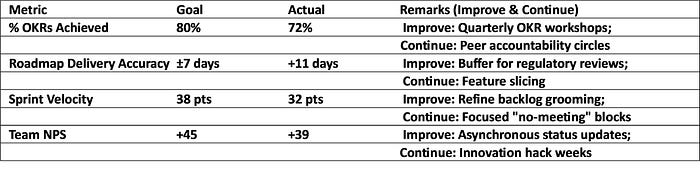
Execution Pulse Score: The Rhythm of Reality
Example in Action: A fintech team notices that their Sprint Velocity is dipping, despite hitting deadlines. The "Remarks" column reveals the cause: compliance documentation drowning engineers. Their fix? Improve by embedding a legal ops specialist into scrums, while continuing their core practice of bug bounty Fridays. Within three sprints, velocity climbs 18%, and Team NPS soars.
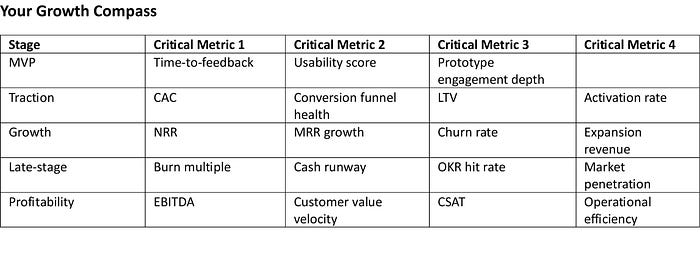
The golden rule is to track what steers decisions, not what decorates pitch decks. A logistics startup exemplifies this by sunsetting "app downloads" (a vanity metric) to focus on Customer Value Velocity — how quickly new users achieve their first successful shipment. This shift exposed onboarding friction that, when addressed, resulted in a 31% increase in EBITDA over one quarter. Metrics become muscles when they move your team daily.
Track what matters, not what looks good.
Conclusion: Vision Needs Rhythm, Not Just Belief
Startups rarely fail due to a lack of ambition or intelligence. What causes most of them to falter is the absence of structured rhythm — rhythm in decision-making, rhythm in communication, and rhythm in execution. Without rhythm, even the boldest vision struggles to survive the friction of everyday operations.
Belief fuels the beginning, but it is rhythm that sustains the journey.
Execution becomes the bridge between what founders intend and what customers experience. It is what transforms vision into value, once, and then again, and again — until consistency becomes credibility.
To create that bridge and ensure it holds:
* Set sharp, stage-appropriate priorities — not everything matters equally at every stage. Knowing what matters now is more valuable than trying to perfect everything at once.
* Communicate frequently and with clarity — silence creates assumptions; clarity creates alignment.
* Involve customers continuously — honest feedback from real usage keeps the product grounded in reality, not assumptions.
* Treat investors as long-term collaborators — align them with your journey, invite them into the problem-solving process, and grow trust through transparency.
* Build execution into routines and rituals — teams may change, but strong execution systems outlast individual brilliance or personality-driven leadership.
Whether you're building an asset tracking platform, an immersive learning environment, an enterprise SaaS solution, or a customer success intelligence engine, the same truth holds that speed without structure exhausts teams. Growth without clarity erodes trust. Strategy without rhythm feels like chaos.
Startups that thrive are not just fast; they are also agile. They are focused.
They operate with intention.
They design for scale, but they execute for today.
And when rhythm becomes part of the organisation's DNA, growth no longer depends on heroic effort. It flows from aligned teams, focused execution, and leadership that evolves with each stage.
Ultimately, sustainable growth is not about chasing every opportunity that comes along; it's about identifying and capitalising on the right ones. It is about building with rhythm, so that every next step stands firmly on the last. That's how vision becomes a reality, and how belief becomes something that lasts.