


These days, .NET interviews are not just about knowing syntax. Interviewers ask you deep and sharp questions to understand how you design code, manage memory, understand application architecture, scale, and build performant apps.
In this blog, you will learn the top 10 questions that will put you far ahead of other developers if you know the answers.
With each question, ✔ Explanation ✔ Wrong answer examples ✔ Best answers ✔ Real-world scenarios ✔ Pro interview tips ✔ Trick questions ✔ Bonus questions
Everything has been added.
1. Difference Between .NET Framework, .NET Core & .NET 5/6/7/8/9 (Unified .NET)
Why is this question so important?
This is a favorite question of interviewers, because they want to know – Do you know old .NET or do you understand modern .NET?
Candidates usually say —
".NET Framework is old and .NET Core is cross-platform."
This is a very low-level answer.
You need to give an architectural answer.
Standard Answers (Interview Level):
.NET Framework
- Only for Windows
- Monolithic
- IIS dependent
- Closed-source (mostly)
- Legacy enterprise apps use this
.NET Core
- Cross-platform
- Lightweight
- High performance
- Open Source
- Microservices friendly
- Kestrel web server
- Docker friendly
.NET 5+ (Unified .NET 5, 6, 7, 8, 9…)
- All workloads on one platform
- Highest performance
- Native AOT
- Cloud optimized
- One Base Class Library (BCL)
Master answer in one line:
".NET Core is modern, modular, cross-platform. Later Microsoft brought all .NET workloads together to create 'Unified .NET' which is currently up to .NET 9."
Interview Trap:
Q. "Is .NET Core dead?"
➡ Answer: No, it is renamed to .NET (5+ onwards).
Q. "Is .NET Framework coming back?"
➡ Answer: No, only security updates.
2. What is Dependency Injection? Why should you use it?
Why is this a Make or Break question?
This question tests your OOP, architecture, design patterns — all of it.
Many people just say —
"DI reduces coupling."
Wrong answer. This is a very low-level answer.
Professional Answer:
Dependency Injection (DI) is a design pattern where you leave dependencies to an external container rather than creating them yourself.
Key Benefits:
- Loose coupling
- Unit testing is easy
- Easy maintenance
- Separation of Concerns
- Constructor Injection (preferred)
- Clean architecture possible
Example :
public class OrderService {
    private readonly IPaymentService _payment;
    public OrderService(IPaymentService payment) {
        _payment = payment;
    }
}
Without DI:
public OrderService() {
    _payment = new PaymentService();
} // BAD
What is the interviewer looking for here?
- Do you understand Lifetime?
- Singleton vs Scoped vs Transient?
- What is circular dependency?
Trap question:
Q. "Why should you avoid Service Locator?"
➡ Because it creates hidden dependencies → code is messy.
3. What is the Difference Between Value Type & Reference Type?
High-Level Explanation:

Example Showing the Difference:
Value type example:
int a = 10;
int b = a;
b = 20;
// a = 10, b = 20
Reference type example:
class Person { public int Age; }
var p1 = new Person() { Age = 20 };
var p2 = p1;
p2.Age = 50;
// p1.Age = 50
Interview Tip:
Is the Heap slow? → Yes, relatively slow. Is the Stack faster? → Yes. Does the Garbage Collector clean the heap? → Yes.
4. Difference Between Interface and Abstract Class
Key Differences Table:
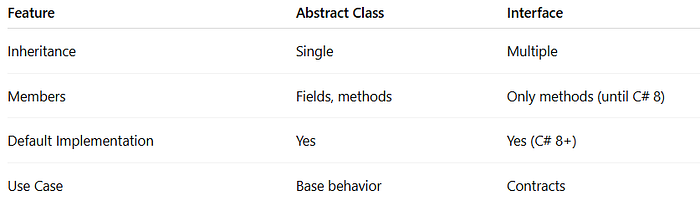
Usage examples
Interface = What do I do (What) Abstract = How do I do it (How)
Trap question:
Q. "Can you create constructor in interface?"
➡ No.
Q. "Can interface contain fields?"
➡ No.
5. What is ASP.NET Core Middleware? Explain Pipeline.
Standard Answer:
Middleware is the pipeline component of request/response.
Pipeline Flow:
- Request enters
- Auth Middleware
- Routing
- Endpoints
- Response returned
Example:
app.Use(async (context, next) => {
    Console.WriteLine("A");
    await next();
    Console.WriteLine("B");
});
Interviewer looking for:
- Order matters? → Yes
- What is Routing Middleware?
- Can you build custom middleware?
6. Async/Await & Task-Based Programming
Master Explanation:
Async/await allows non-blocking I/O → remains thread free → high scalability.
All current .NET high-performance APIs are asynchronous.
Example :
public async Task<string> GetDataAsync() {
    return await File.ReadAllTextAsync("a.txt");
}
Trap question:
Q. "Is async always faster?"
➡ No. It improves scalability, not raw CPU speed.
7. What is Entity Framework Core? How does LINQ query work?
Knowing EF Core Internals = Big Advantage
EF Core translates LINQ queries into Expression Tree → SQL.
Common EF Questions:
- Lazy loading vs Eager loading
- What is Change Tracker?
- What is Migrations?
Example :
var users = await _db.Users.Where(x => x.IsActive).ToListAsync();8. What is Garbage Collection (GC)?
GC Phases:
- Mark
- Sweep
- Compact
GC Generations:
- Gen 0
- Gen 1
- Gen 2
- LOH (Large Object Heap)
Trap Question :
Q. "Can you manually force GC?"
➡ Yes → GC.Collect()
But it's a BAD practice.
9. What are SOLID Principles? Explain at least two.
SRP Example (Correct):
class InvoicePrinter { }
class InvoiceCalculator { }
DIP Example :
public Notification(IMessageService service) { }Interview Tip:
Product companies ask for SOLID principles 98% of the time.
10. What is JWT Authentication? Explain Flow.
Flow:
- User login
- Server creates token
- Client stores token
- Client sends token in each request
- The server validates the token
Example Configuration :
builder.Services.AddAuthentication()
    .AddJwtBearer();
Trap Question :
Q. "Where should you store JWT? LocalStorage or Cookie?"
➡ Cookie (HttpOnly+Secure) is safer.